
An Interview with Desiree Arias from Desiree’s Pawdicures
If you are like me you have, at one time or another, struggled to trim your dog’s nails. I dread hearing the clack clack clack on the floor because I know that soon it is time to bring out the nail clippers and my dogs are not fond of having their nails clipped.
In my four part interview with Desiree from Desiree’s Pawdicures, I hope to make this nail clipping process a little less daunting and learn some strategies to not only make the clipping process easier for both dog and human but also about what to do when problems arise.
About Desiree Airius
Desiree has been clipping nails for almost twenty years. She started as a teenager while completing a work experience program in a vet clinic. Desiree grew up with animals and knew that working with animals was what she wanted to do, and the one-on-one experience that she got while working as a student only served to confirm that. While working her day job, Desiree also finds the time to provide a mobile in-home nail clipping, ear cleaning and anal gland expression service for those pets and owners who are most comfortable having these procedures done in the comfort of their own homes.

Part 1: Clipping Basics
What are the basic things that every pet owner should know about trimming their pet’s nails?
Having the proper clippers is very important. Knowing how to handle your dog and hopefully knowing how they’re going to react to it, because some dogs really do not like it and some dogs are pretty good about it. Most are not I would say, so having treats is a very good idea as well as knowing the correct time to give the treats as you don’t want to reward your dog for bad behavior. Understanding that if you’re nervous cutting your dog’s nails they are going to know that so that will make it a little more difficult because if you’re not confident in yourself then your dog will not be confident in you.
What types of nail clippers should you use?
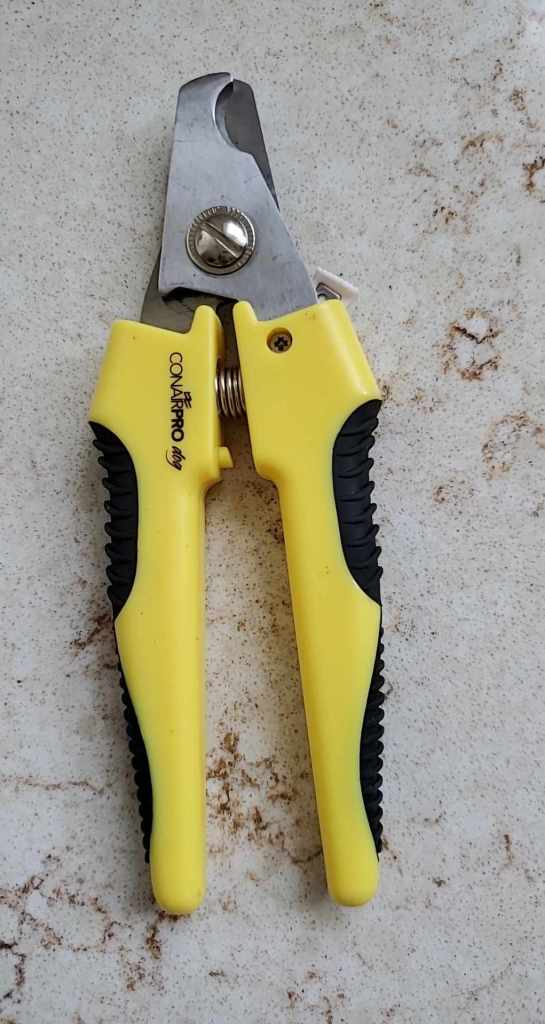
I use the ones that look like scissors. The ones that look like guillotines will crack and break nails.
When you cut it back you said that you cut it to the pink, is that with a white nail?
Yes, so the black nails usually have black quicks and then the white nails usually have pink quicks. You have to be very careful because the quicks do taper so the tip is very tiny, and it is hard to see. If you are not careful they will bleed.
That leads me to my next question. My dogs have completely black nails. How do you know how far back to go when the nails are all black you have a hard time seeing the black quick?
You literally go little-by-little and shave off tiny bits at a time. If I’ve known the dog for a long time and you can obviously see where the quick is you can take a good chunk off, however with the dark nails it is more difficult and you take it off little-by-little.
Can you see when you look at the end of the nail if you are getting close to the quick?
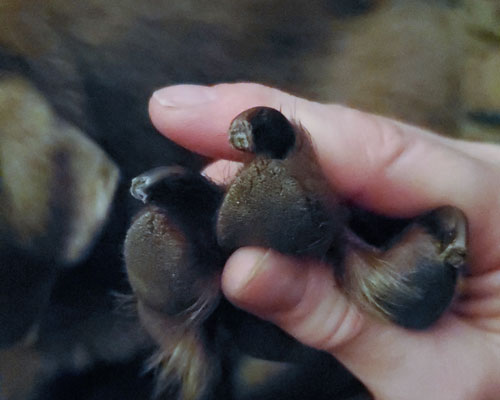
Yes, there’s a tiny circle and on a black nail it’s still black but it’s not as black as the outside of the nail. On the white nails it’s a pink circle, and the closer to the nail bed the more pink it is. When you first cut it might be just an off shade of white.
What is the ideal length of the nail?
They shouldn’t even be on the floor, they should be ideally just off the floor. What happens especially as pets age, when their nails are constantly on the ground is it actually causes them to change their gate so they lean a little bit more forward resulting in more weight on their joints. As they get older this can cause them to get very arthritic and then trimming their nails is more difficult because it is just really uncomfortable. Keeping them short is good as it also makes them rock back on their pads and their pads are meant to take all the weight so they can walk properly. You can see that some dogs like Dachshunds are very toed out and their nails will be dragging on the side. If the toes are really high off the ground then their nails tend to curl and if they’re really low on the ground the nails tend to grow out and in front of them. Their gait can actually affect how their nails grow so if they’re just off the ground and they’re walking on their pads then their nails will go straight and be strong but they won’t be impeding the way they walk.
If the nail gets too long and you trim it a little bit at a time will the quick back up?
Yes that’s exactly what happens. When I have a client whose dogs have really long nails what I do is I’ll cut the nail to just the very, very tip of the quick so that when I cut it I can see a tiny little circle of either black or pink, so I’ve exposed just the tip of the quick, and I don’t cut anymore. Then I’ll come back in 2 weeks and I will do it again because 2 weeks seems to be the ideal time that the nail will then cover and hide the quick but it will not extend it longer. I will come and re expose it, so depending on the length of the nail, I might come back every 2 weeks for a couple months and eventually the quick will retreat and that’s how you get the actual length of the quick back.
Should pet owners use a Dremel tool for nail trimming?
I don’t use dremels and I’ve only had one client ask me if I would use a dremel on their pet’s nails. I don’t like them because I find that it takes longer and it’s easier to quick a pet with it. Because they take such a long time, people don’t pay attention and so they will just hold it on and hold it on and then shoot you’ve gone too far now and there’s blood. In my case because I deal with a lot of fearful dogs, they are in that fearful state of mind for even longer and then it’s more likely to become a traumatizing event. I like it to be quick and painless so they learn that it was not a big deal. I know in a lot of grooming salons they use them now. I had one client that took his dog into the groomers and he wasn’t happy with the way they did the dog’s nails and asked me what I thought of them. I looked at them and it looked like the nails had literally been melted at the tips.
In this segment of our interview, Desiree explained to us what equipment she recommends we use to clip our pet’s nails, the ideal length of the nail and how to tell if you have reached the quick. Please subscribe to Silver Hound Studios to be notified when the second part of this series is posted. In that post Desiree will outline common challenges of nail clipping and give us some ideas on how to overcome them.
If you have any questions for Desiree, feel free to post them below. If you are interested in Desiree’s services for your dog, cat or other animal, she can be contacted through her Facebook Business Page “Desiree’s Pawdicures”.
 Calgary and Area Private and Commercial Pet & Equine Photographer
Leave a comment